Your first morning at insect scale
This guide walks you through your first session as a tiny photographer in a Toronto park. You will learn how to read the landscape, move with purpose and take your first satisfying shots.

Waking up among the grass stems
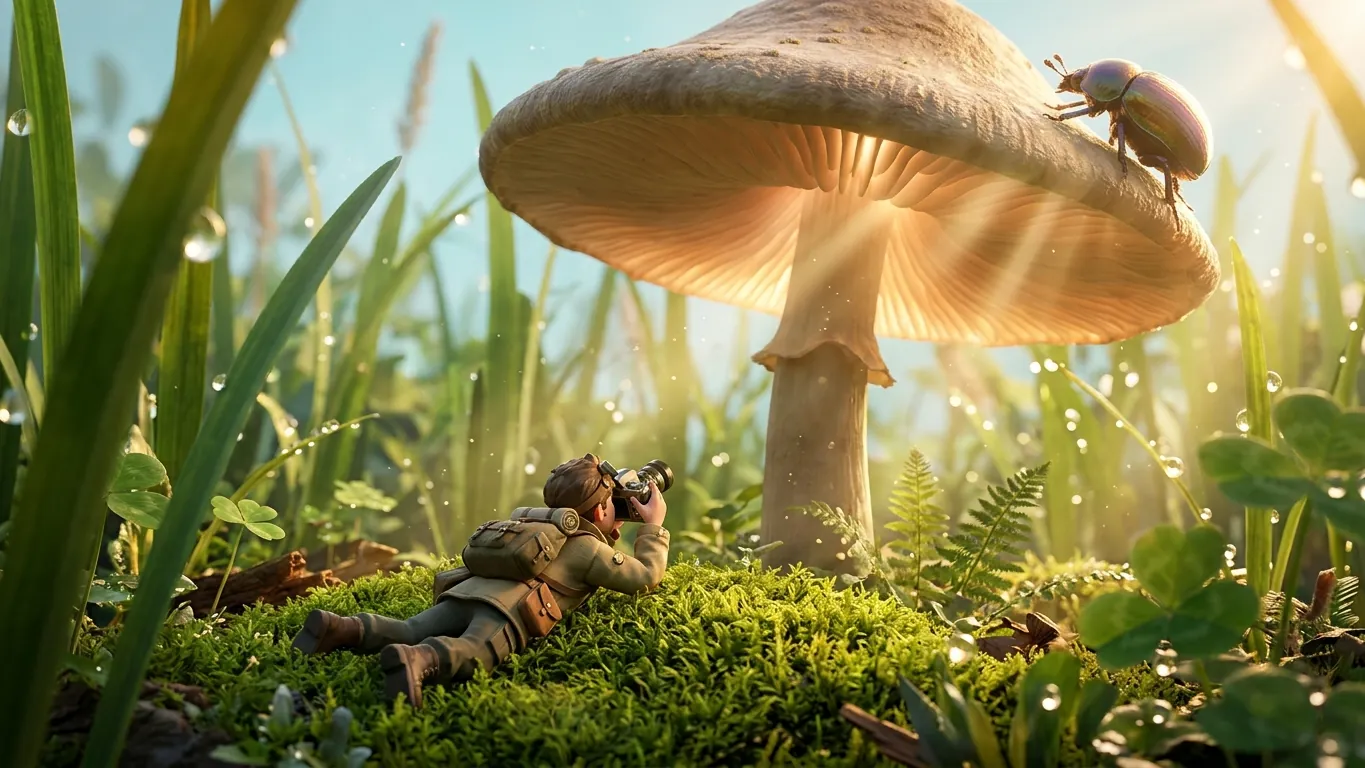
The first thing you notice after shrinking down is scale. A patch of lawn you would cross in two steps at normal size now stretches out like a forest. Grass blades rise above you, a fallen leaf becomes a wide plateau and a pebble turns into a small hill.
Take a moment to simply look around before you raise the camera. The game rewards curiosity, and the park is full of small scenes that only reveal themselves when you slow down. Watch how the light filters through the grass, where the dew has gathered and which creatures are moving nearby. That quiet first look gives you a mental map of what is worth photographing.
Reading the park like a tiny photographer
At insect scale, the park is made of layers. Down low you have soil, moss and fallen seeds. In the middle you find grass stems, clover and small flowers. Higher up are mushroom caps, leaf edges and the undersides of petals. Each layer offers a different kind of photo.
Beetles and other small creatures tend to move along edges and surfaces, so following a stem or a leaf vein often leads you to a subject. Dewdrops collect where leaves bend, and they catch the morning light beautifully. Mushrooms make useful lookout points, letting you scan a wider area before choosing where to head next.
Try thinking of each spot not as a single photo but as a small set: a wide view that shows the place, a medium shot of a subject and a close detail.

A calm first session, step by step
If you are unsure how to begin, this simple routine helps you settle in without feeling rushed.
- 01
Explore before you shoot
Walk a small loop around your starting area and note interesting subjects such as a beetle, a dewdrop or an unusual leaf.
- 02
Check your journal
Open the journal to see which photo tasks are available. They give you a gentle direction for the session.
- 03
Pick one subject
Choose a single subject and give it your full attention instead of trying to capture everything at once.
- 04
Try different angles
Shoot from the side, from below and from slightly above. Compare how each choice changes the mood.
- 05
Review and keep the strongest
Look at your photos and keep the ones you like most for your collection. Every review teaches you something.
Small habits that help early on
A few habits make the early hours more enjoyable. First, move slowly near creatures. Rushing towards a beetle is a quick way to miss the shot, while a patient approach gives you time to pick an angle.
Second, pay attention to the light. The soft morning light is one of the most appealing parts of the game, and it changes how surfaces look. A dewdrop that seems flat from one side may sparkle from another.
Third, do not chase perfection on every photo. Some of your favourite images may come from happy accidents, like a beetle stepping into frame just as you focus on a leaf. Keep shooting, keep reviewing and enjoy the process.
When a shot does not work out
Every photographer takes plenty of photos that do not quite land, and that is part of learning. If a shot feels dull, ask yourself three questions. Was the angle interesting? Was the focus on the right spot? Did you press the shutter at a good moment?
Usually one of those answers points the way to a better attempt. Move a little, refocus or wait a few seconds and try again. Over time these adjustments become second nature, and the grass jungle starts to feel less like a maze and more like your own outdoor studio.
Related articles
 Choosing angles in a world of giants
Learn how low, high and side angles change your photos in the tiny park world, and how to use plants, light and space to frame beetles and dewdrops.
Read more
 Focus and depth, explained simply
A friendly explainer on focus in the macro park game: where to place the focus point, why backgrounds blur and how to make beetles and dewdrops stand out.
Read more
 Timing the shot in soft morning light
Tips on timing your photos in the tiny park world: working with soft morning light, waiting for beetles to move and catching dewdrops at the right moment.
Read more